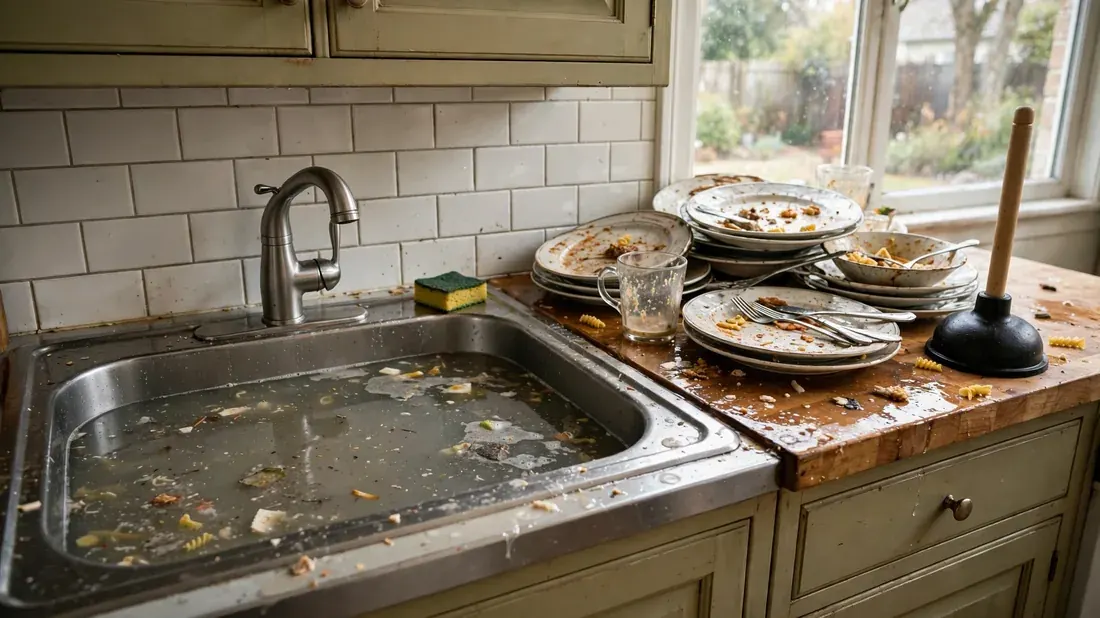
One slow drain is an annoyance with a short list of causes: hair in the trap, a partial clog in that fixture's branch, a vent issue on one line. Slow drains throughout the house — tub, sinks, toilets all hesitating together — are something else entirely. The fixtures share almost nothing except one thing: everything they drain passes through the main line on its way out of the house.
That shared path is where whole-house slowness lives. This guide explains what restricts a main line in central Ohio homes, how to read the early warnings before they become a backup, why the chemical bottle is the wrong tool, and how a camera inspection turns guesses into a decision.
The anatomy: everything meets at the main
Each fixture in your home drains through its own branch line, and the branches join progressively larger pipes until everything — kitchen, baths, laundry — converges on the building drain inside the house and the sewer lateral outside it, running to the street. A restriction anywhere downstream of the convergence slows everything upstream of it. A restriction in one branch slows only that branch's fixture.
That is the whole diagnostic logic of whole-house slowness, and it gives you the first test for free: if the kitchen sink is slow but the tub runs clear, the problem is the kitchen's branch. If the tub, the bathroom sink and the kitchen all hesitate — and especially if the lowest fixtures in the house hesitate worst — the restriction is in the shared line, and it is not a fixture problem no matter how it first appeared.
Toilets deserve special attention in this picture, because they move the most water at once. A toilet that gurgles when the washer drains, or bubbles when a tub empties, is reporting pressure and air movement in a shared line that is no longer flowing freely. Gurgling is the main line talking. Learn to hear it early.
The usual restrictions: roots, scale, bellies and grease
In the older cities of this service area — Columbus's inner neighborhoods, Newark, Lancaster, Mansfield, Marion and the other county seats — the leading cause is tree roots in clay or cast-iron laterals. Clay pipe was installed in short sections with joints every few feet, and those joints are where the pipe meets the soil. Roots find the moisture at a joint, enter as fine hairs, and thicken year by year into a mat that catches everything passing. The cruel arithmetic: a line can be 90% root mass and still drain — slowly — until one high-volume day finishes it.
Cast-iron drains restrict from the inside: decades of flow roughen and scale the interior, narrowing the bore and giving debris a surface to catch on. Grease does the same in any material — poured warm, plated cold, layer on layer, worst in the flat runs below kitchen lines. And where the ground has shifted or the original bedding settled, a pipe develops a belly: a sagging section that holds standing water and everything heavy in it, a permanent partial clog built into the line's shape.
Each cause has the same symptom from the fixtures — whole-house slowness — and a different remedy, which is exactly why the inspection step, a few sections down, matters more than the cleaning step. Cleaning a root-filled line buys time; cleaning a bellied line buys almost none; the fixtures cannot tell you which you own.
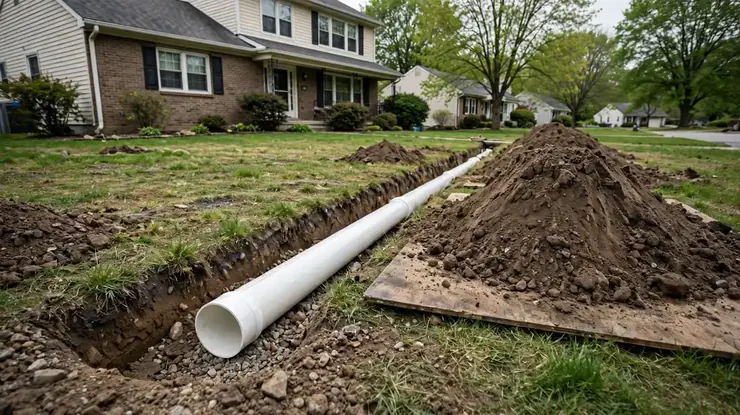
Reading the warnings: the lowest drain tells the truth
A restricting main line announces itself in a sequence, and homeowners who recognize the early items rarely meet the last one. The sequence usually runs: drains slower than they were, in several rooms. Then sounds — gurgling toilets, a tub that sighs as it drains. Then the floor drain or the lowest fixture in the house begins to show the strain: a basement floor drain that burps, a laundry standpipe that foams higher than it used to, a first-floor toilet that flushes weakly when the washer is running.
The lowest drain is the line's pressure gauge because it is the first place a surcharge appears. When the main runs near capacity, the excess shows at the lowest opening — water rising in a floor drain during a shower upstairs is not a floor-drain problem at all; it is the main line, visible from below.
The warning worth acting on first is any change involving sewage, not just water: an odor at the floor drain, residue around its rim, or — the final item in the sequence — water that came up carrying what should only go down. At that point the line is no longer warning; it is failing on schedule, and the remaining question is whether the failure day is a scheduled visit or a flooded basement.
Why the chemical bottle is the wrong tool
It is understandable: the drains are slow, the bottle promises to dissolve the problem by dinner, and calling a plumber feels like the escalation. But against a main-line restriction, chemical drain cleaners fail on physics before they fail on chemistry. The clog is usually roots, scale or a sagging section full of standing water — tens of feet from the fixture where the chemical is poured, diluted by every gallon in the line, against materials (roots, pipe scale) that household chemicals barely touch.
What the chemical does do is sit in the line, caustic and hot, where it can damage older pipe, soften plastic joints' cement in quantity, and wait — a genuine hazard — for the plumber who later opens that line or runs a cable through it. Splash-back of chemical-laden water from a backed-up line is one of the more avoidable injuries in this trade.
There is a narrow legitimate use: a single slow fixture drain with a hair-and-soap clog near the trap, where mechanical clearing — a hand snake, a trap removal and cleaning — still works better and leaves nothing caustic in the pipe. For anything whole-house, skip the bottle entirely. The money it costs is better spent on the inspection that identifies the actual restriction.
The camera: how the line gets read
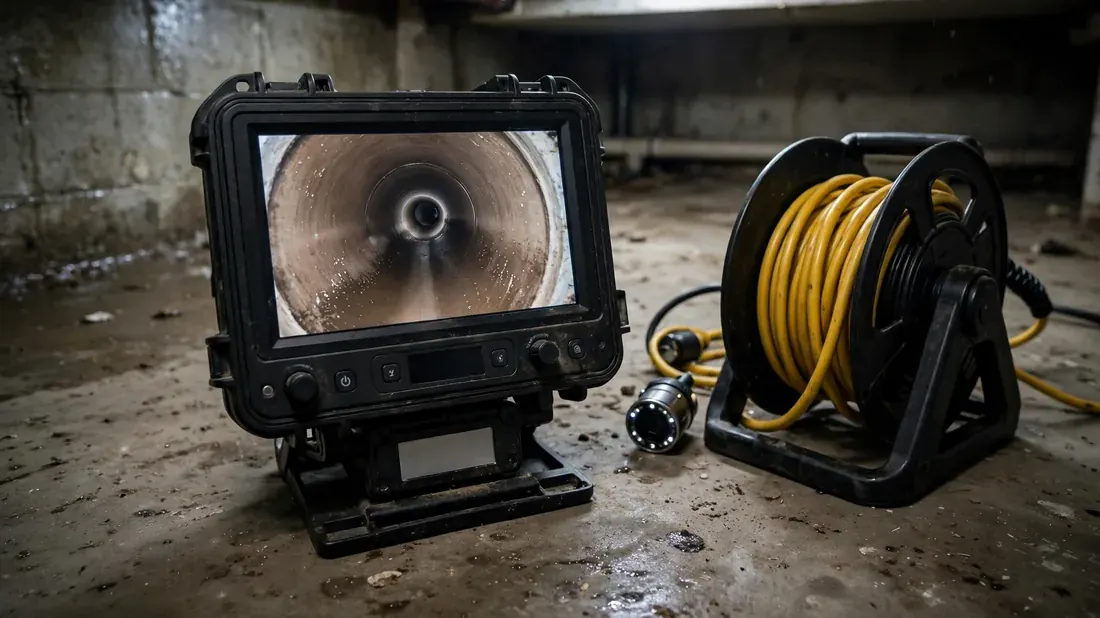
A sewer camera inspection sends a small camera head through the line, usually from a cleanout, traveling the full run to the street while the operator watches the interior on a monitor. In the space of one visit it answers the questions that fixtures cannot: Is the restriction roots, scale, grease or collapse? At what distance, and how extensive? Are the joints sound or offset? Does the line belly anywhere? Is the pipe clay, cast iron, Orangeburg-era material or plastic, and what condition is it in overall?
Distance matters more than homeowners expect. A root mass at one joint twenty feet out is a different job from roots at every joint for sixty feet. A single offset can be a spot repair; a line that has ovalled and cracked along its length is a replacement conversation. The camera converts all of that from opinion into footage you can watch yourself — and any plumber working on a main line should be willing to show you the line, not just describe it.
The inspection also separates your problem from the city's: the lateral from house to street main is the homeowner's in most local arrangements, while the street main is the city's. A camera that reaches a clear house line and finds the restriction beyond the connection has just saved you a repair that was never yours.
Cleaning, jetting or repair: what each outcome means
Once the line has been read, the remedies sort themselves. Cabling — a rotating cutting head run through the line — is the classic root treatment: it restores flow by cutting the mass back to the pipe walls. On a structurally sound clay line, cabling on a schedule is a legitimate long-term strategy; the roots return, but so does the cable, and the arithmetic can favor maintenance for years.
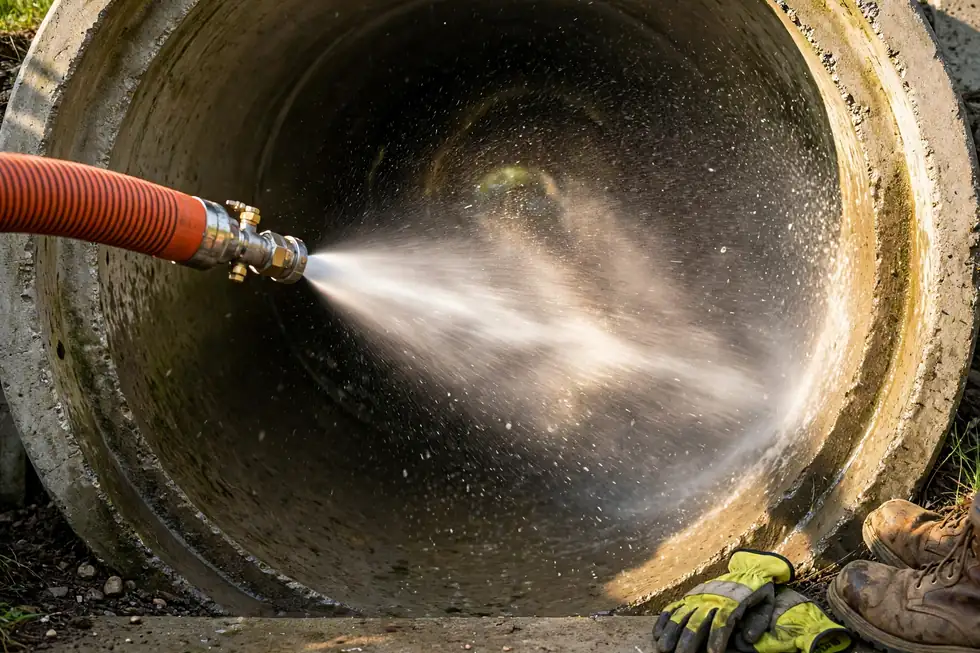
Hydro jetting scours rather than cuts: high-pressure water strips grease, scale and root hairs from the pipe walls, restoring close to the full original bore. It is the right tool for grease-choked and scaled lines and the better reset before judging a line's true condition — a jetted line shows the camera its real walls.
Repair is for what cleaning cannot change: offset joints that catch everything, cracked or collapsed sections, bellies that hold water permanently. Spot repair fixes one location, sometimes from inside the pipe without digging; replacement renews the run. The camera footage is what makes this a judgment instead of a sales pitch — you should be able to see the damage that justifies the digging.
A word on timing: slow is the early stage
Every main-line failure passes through the slow stage first. Roots thicken over seasons; scale narrows over years; a belly collects gradually. The slow stage is when the remedies are simplest and schedulable — an inspection on a calm Tuesday, a cleaning booked into a route, a repair planned rather than excavated through a flooded basement.
The expensive stage announces itself with sewage in the lowest level of the house, and it selects its own timing: a holiday, a houseful of guests, the wettest week of spring when every line in the county is straining. Homeowners who act on whole-house slowness when it is merely slowness are not being cautious. They are being economical — the same work, bought at the calm price instead of the emergency one.
Get Help With Plumbing in Columbus & Central Ohio
Guides explain the system; they do not turn a wrench. If this one ends at "this needs a plumber", call the intake line, describe what you found, and get matched with an independent local plumber who serves your city.
📞 Call (610) 992-4884