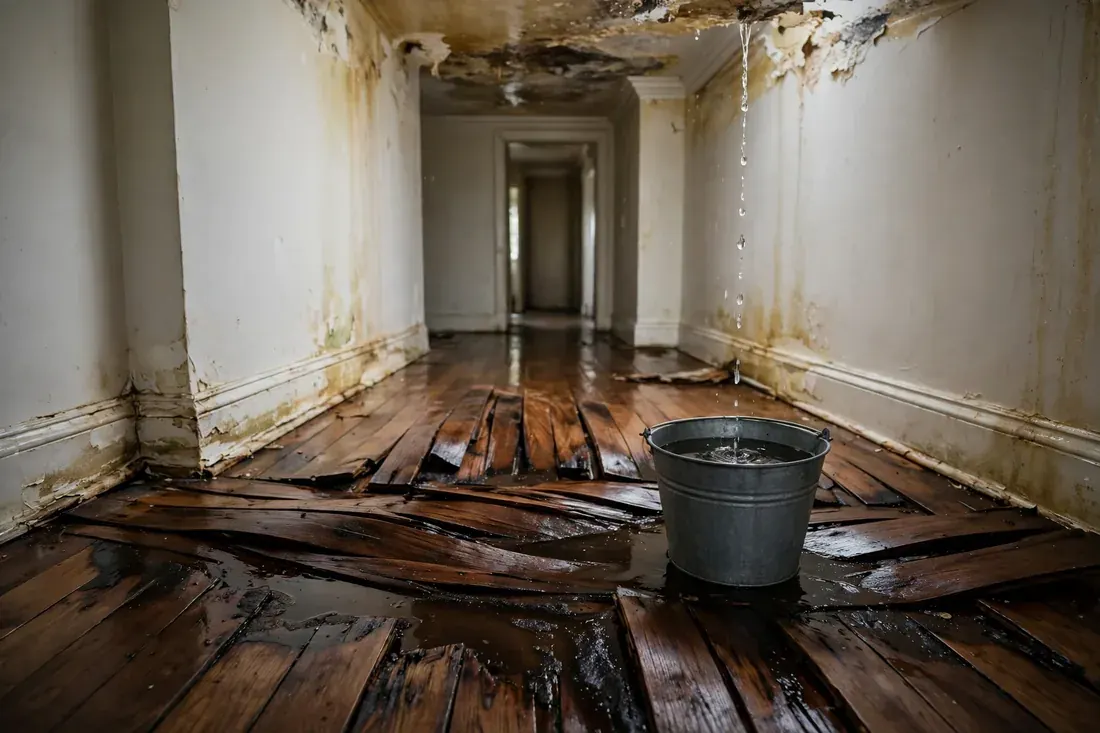
The expensive leaks are rarely the dramatic ones. A burst pipe announces itself and gets fixed the same day. The leak that costs real money is the quiet one: a pinhole in a wall run, a weeping slab line, a supply fitting misting inside a cabinet — losing water for months while it rots framing, feeds mold and swells a water bill the household explains away.
Hidden leaks are findable, and earlier than most people think. This guide covers the signs, the meter test that settles whether you have a leak at all, the places leaks hide in central Ohio homes, what professional detection actually does, and the first moves when you find one.
The signs, in the order they usually appear
The water bill is usually the first witness. A household's usage is remarkably stable month to month; a bill that climbs without a change in the household — no guests, no new irrigation, no filled pool — is water going somewhere unbilled by any fixture. Do not wait for a dramatic jump: a 10 to 15 percent creep sustained over two or three bills is a leak pattern, not weather.
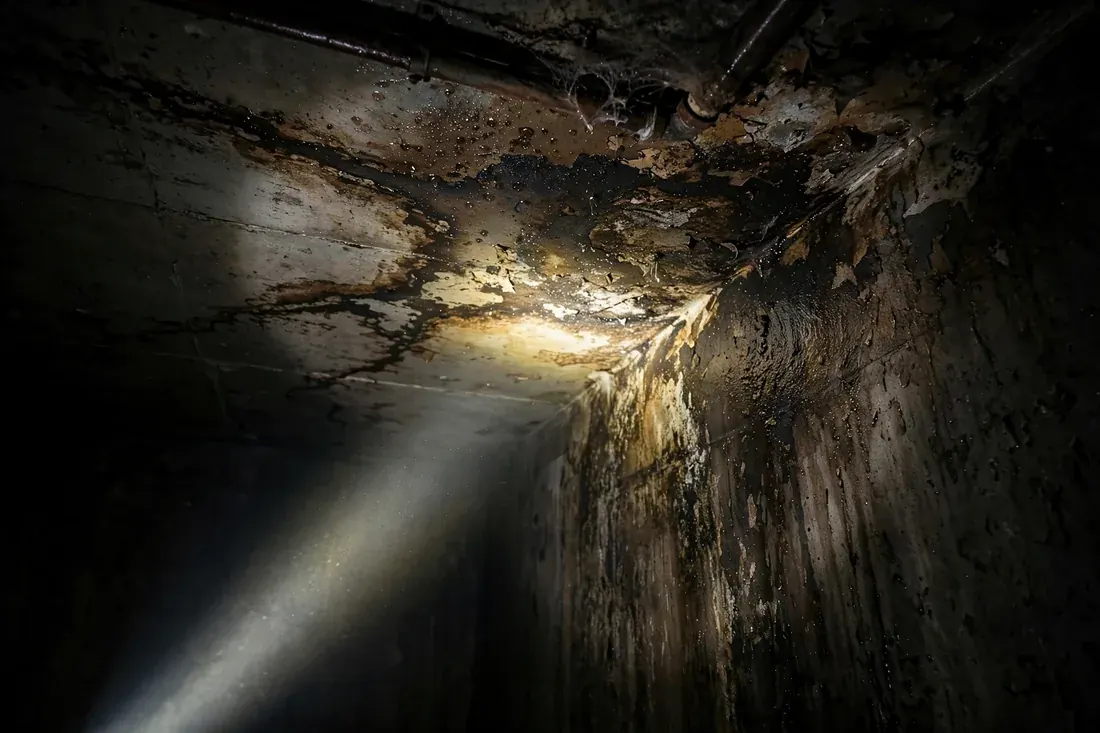
The house itself testifies next. Musty smells that no cleaning removes, especially in one room or one cabinet. Paint that bubbles or peels along the bottom of a wall. Flooring that warps, cups or feels soft or warm in a spot with no spill to explain it. A ceiling stain that grows slowly enough to be re-explained every month. Mold appearing at a baseboard far from any bathroom humidity. Each of these is water, present where it should not be, over time.
And there are sounds: the faint hiss or trickle in a quiet house with every fixture off, water moving somewhere it was not sent. If the house has a water softener or filter, learn its normal regen sounds so the abnormal ones stand out. Leaks are rarely silent; they are merely unlistened-to.
The meter test: settle the question in twenty minutes
Before searching for a leak, confirm you have one. Your water meter will tell you. Pick a period when no water will be used — no laundry, no dishwasher cycle pending, nobody showering. Read the meter, or better, note the position of the small low-flow indicator (the little dial, star or triangle on the meter face that moves with even tiny flows). Wait one to two hours with everything off. Read again.
If the indicator moved with all fixtures off, water is leaving the system somewhere. Before concluding, eliminate the two innocent movers: toilets (the most common household water loss, and the subject of the next section's first hiding place) and any automatic systems — softener regeneration, humidifiers, irrigation. Shut the supply valves to the toilets and repeat the test if needed; a leak that stops when the toilets are isolated has told you its address.
A positive meter test with toilets isolated means a supply-side leak: a line in a wall, under a floor, in the slab or in the service line from the street. That is the finding that justifies professional detection rather than demolition-by-guess — locating is a solvable problem, as a later section explains.
The hiding places, most likely first
Toilets, first, because they are the champion silent loser of household water: a flapper that no longer seals lets the tank drain into the bowl continuously and invisibly — the toilet refills every few minutes forever, using water without a single visible drop out of place. The dye test finds it: food coloring in the tank, wait fifteen minutes without flushing, and color in the bowl means the flapper leaks. It is a leak in every sense that matters to your bill.
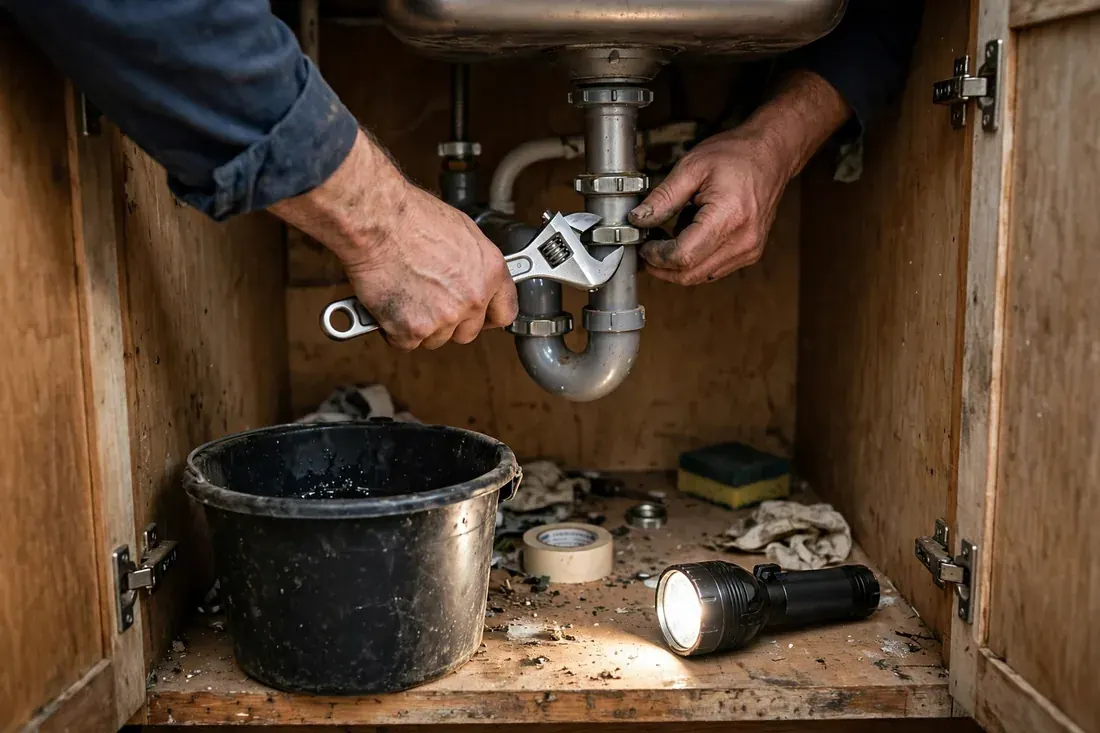
Supply fittings under sinks and behind appliances are next: angle stops, flexible connectors and dishwasher and ice-maker lines that weep at a rate too slow to drip audibly but fast enough to rot a cabinet floor over a season. Slide a dry hand or a paper towel along every fitting you can reach — moisture on the towel is evidence, and the cabinet floor's condition tells you how long it has been going on.
Water heaters leak from drain valves, relief valves and eventually the tank itself; a heater in a finished area should be looked at, not just listened for. In the walls and under floors, pinhole leaks in aging copper and end-of-life galvanized runs in the region's older housing mist into framing for months. And under slabs — common in the area's ranch housing — a supply line leak announces itself only as a warm floor spot, a bill, and eventually undermined soil and a settling crack if it runs long enough.
What professional leak detection actually does
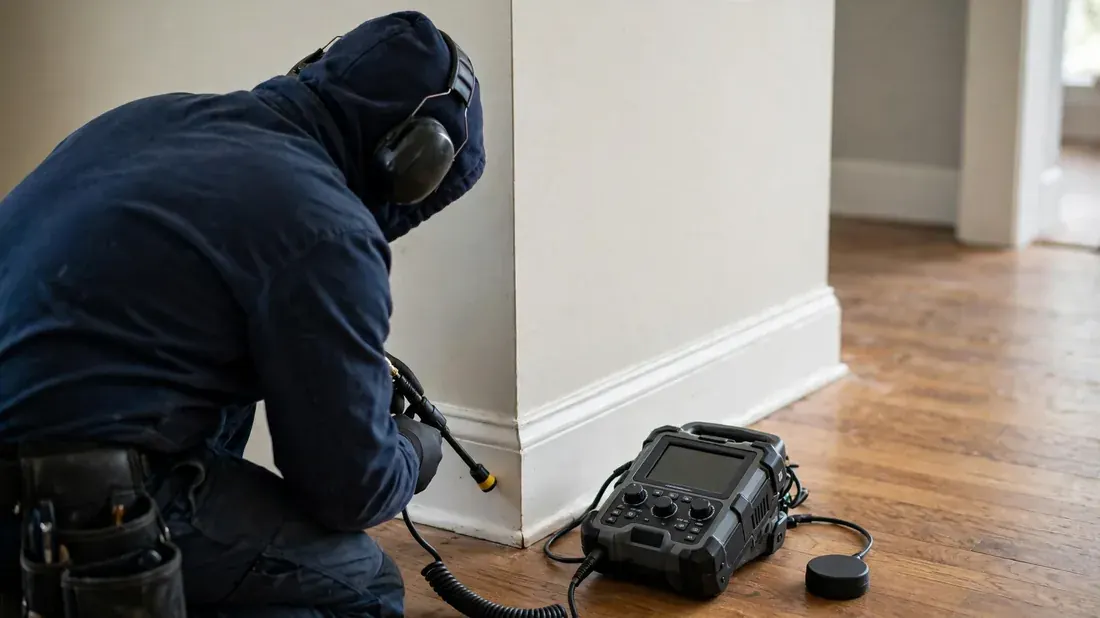
The fear that stops people calling is the image of a plumber opening walls at random until water appears. Modern detection exists precisely to avoid that. The core tool is acoustic: pressurized water escaping a pipe makes a sound, and ground microphones and listening equipment trace that sound along the line's path, narrowing the leak to a location — often within a very small area — before anything is opened.
Thermal imaging supports it: a camera that sees temperature shows hot-water leaks as warm signatures spreading through floors and walls, and moisture patterns that the eye cannot see. Pressure testing isolates sections of the system so the search narrows by elimination — this branch holds pressure, that one does not — until the suspect run is short enough to listen to precisely.
The result is a marked location and a defined scope: open here, this much, repair this section. Compare the alternative — the leak itself, given months, opens the house in its own way, with rot and mold choosing the extent. Detection is not the drastic option in that comparison. It is the small one, done early.
Found one? The first moves
Slow the water first. If the leak is at a fixture or appliance, its local shut-off stops it. If you do not know where it is, or it is in a wall or slab, the main shut-off is the move — every adult in the home should know its location before an emergency teaches it, and this is a good week to make sure of that. Take photographs of the damage and the meter reading; if you will involve your insurer, documentation from the first hour is worth more than reconstruction later.
Then dry what you can reach: towels, a fan moving air across wet material, cabinets opened to air. Mold begins colonizing wet material within a day or two, so the drying clock matters as much as the repair clock. Do not seal a wet wall cavity behind new paint or patch — trapped moisture is how a repaired leak becomes a mold project.
And treat the discovery as information about the system, not just the spot. A pinhole in one section of aging copper is a message about the run it belongs to; a slab leak repaired at one point often justifies a conversation about rerouting the line entirely, so the next failure is in an accessible place. The plumber who fixes the leak should be willing to have that conversation with the evidence in front of you.
The maintenance version: catching leaks while they are small
Most hidden leaks are found late because nothing in the household's routine looks for them. Three habits change that. Read the meter yourself a few times a year, the same twenty-minute test described above — it converts leak discovery from accident to schedule. Look at the water bill as a diagnostic, not a tax: any unexplained sustained rise gets investigated, not absorbed. And once or twice a year, walk the house slowly with leak eyes: under every sink with a flashlight and a dry paper towel, around the water heater, at the base of every toilet, along the basement ceiling below the bathrooms.
None of that requires skill — it requires only the knowledge that leaks hide, bill and rot simultaneously, and that the household that goes looking finds them in the early stage. The water you are paying for should come out of a fixture on purpose. Everything else is a findable, fixable problem — the sooner, the smaller.
Get Help With Plumbing in Columbus & Central Ohio
Guides explain the system; they do not turn a wrench. If this one ends at "this needs a plumber", call the intake line, describe what you found, and get matched with an independent local plumber who serves your city.
📞 Call (610) 992-4884