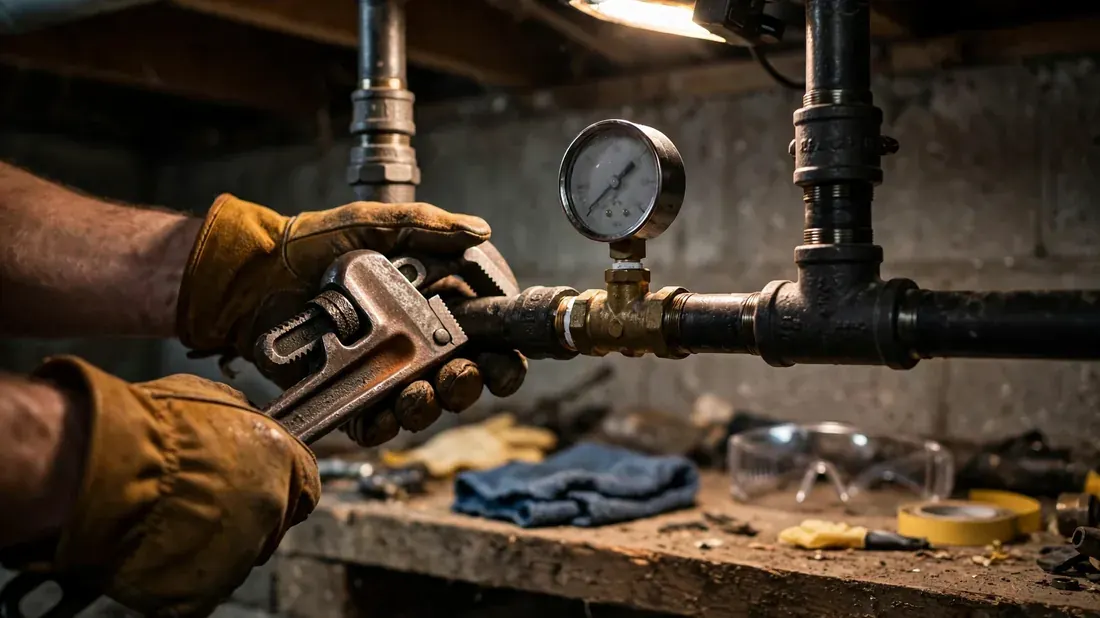
Gas work allows no improvisation. A sulfur smell near a line, corrosion eating at black iron pipe, or an appliance project that needs a line moved or extended — each calls for methodical work and a pressure test at the end. Columbus Plumbing Help connects Columbus homeowners with local plumbers who handle gas lines carefully and verify every joint before the gas is left on.

Natural gas lines in Columbus homes are typically black iron pipe, with corrugated stainless tubing in some newer work. The iron system's enemies are time and moisture: threads and joints corrode where lines pass through damp basements and crawl spaces, valves stiffen and weep, and old flexible connectors to appliances fatigue. A gas leak rarely announces itself loudly — the added odorant's sulfur smell at low concentration, a hissing near a fitting, dead vegetation over a buried yard line, or a meter that moves with everything off.
The first rule of a suspected leak is not a plumbing rule at all: if you smell strong gas, leave the house and call the gas utility's emergency line or 911 from outside. Nothing in this page outranks that. The work described here is for the repair itself — the corroded section, the weeping valve, the planned extension — handled once the situation is safe and, where the utility has shut the meter, coordinated with their requirements for restoring service.
Planned gas work is the other half of this service: a line for a new range or dryer, a fireplace run, moving a line for a remodel, or replacing a water heater's supply. Each addition changes the load on the system, so sizing — total demand against line capacity — is calculated, not assumed, and the finished work is pressure-tested before it is trusted.
A single weeping valve or one corroded section is a contained job. Scope grows with the number of failing sections the testing reveals — pressure testing is honest that way — and with new runs, where distance from the main line, total system load and access through finished spaces shape the work. Buried yard lines are their own category, located and assessed separately.
Emergency safety always outranks scope: where the utility has shut off service over a leak, their re-inspection requirements become part of the plan, and the confirmed scope includes what restoration of service requires. You approve the work with that full picture in front of you.
Suspect sections are tested and isolated so the failing joint or run is identified precisely — soap testing, pressure testing and valve-by-valve isolation rather than guesswork.
Rusted pipe and failed fittings are cut out and replaced in kind, with threads sealed and supported correctly, ending the corrosion pattern instead of coating over it.
Appliance shut-off valves that are stiff, ancient or weeping are replaced with modern quarter-turn valves you can actually close in an emergency.
Supply lines sized and run for ranges, dryers, fireplaces, water heaters and furnaces, including the demand calculation for the whole system.
Lines rerouted for remodels, and abandoned branches capped safely at the source — not left as dead legs holding gas.
Every job ends with the system pressure-tested and every new joint checked. Gas is left on only over work that has proven itself tight.
Say what you smell, see or plan. If the smell is strong, you will be told to leave and call the utility first — that advice outranks booking any repair.
The suspect area is shut down and the failure located by pressure and joint testing, so the repair scope is the failing section, not the whole system.
Replacement sections, valve work or new runs are laid out and confirmed before tools come out.
Pipe is cut, threaded, fitted and supported to standard, with shut-offs where the work calls for them.
The finished system is pressure-tested, joints verified, appliances relit and checked, and the work area left safe.
A gauge on the isolated system, watched over time: the objective proof that a line holds. Feelings do not certify gas work; numbers do.
Joint-by-joint checking with detection fluid and electronic sensing to find weeps too small to smell.
Black iron lives or dies at its threads — cut square, sealed properly, wrenched to the right tightness without cracking fittings.
Every appliance's demand totaled against line size and length, so a new run never starves the furnace on the coldest night.
A faint sulfur note near the stove and an ancient gate valve that had not moved in years, weeping at its stem.
Line isolated, valve replaced with a modern quarter-turn shut-off, joint tested tight, and the range back in service.
Black iron flaking and pitted where the line crosses a damp wall, the rust pattern years deep.
The affected section cut out and replaced, supports corrected to keep the new pipe clear of the damp, and the system pressure-tested.
A laundry room plumbed for electric, a homeowner switching to gas, and no supply within reach.
A properly sized branch run from the main line with its own shut-off, tested and ready for the appliance installer.
The situations this service exists for — described the way homeowners describe them on the call.
Most gas leaks found on service calls are small and old — weeping joints and corroded threads. They are also unforgiving of delay. Locating and repairing them early is the entire point.
Ranges, dryers, fireplaces and tankless heaters all wait on a gas supply that is sized and legal. Planned line work unblocks the project safely.
Original black iron in older Columbus homes eventually corrodes through. Section-by-section replacement renews the system without rebuilding it all at once.
If the smell is strong or you feel unwell: leave the house without touching switches or appliances, and from outside call the gas utility's emergency line or 911. Do not try to find the leak yourself. Once the utility has made the situation safe and identified what needs repair, that repair is the call to make here.
By isolating sections of the system and testing them: pressure gauges that reveal which run cannot hold, detection fluid or electronic sensing at individual joints, and valve-by-valve checks. The method narrows to the failing joint or section so the repair replaces what failed instead of disturbing the whole system.
Yes — ranges, dryers, fireplaces and heaters are routine additions. The key step is the load calculation: the new appliance's demand is added to the existing total and checked against the size of the main run, so nothing downstream is starved. The new branch gets its own shut-off valve and a pressure test with the rest of the work.
Usually not. Corrosion concentrates where moisture lives — a damp wall crossing, a low run near a floor. Testing identifies which sections are actually compromised, and sound iron elsewhere in the system can remain in service. The scope follows the evidence, section by section.
That the isolated system holds a set pressure over a measured time without dropping — the objective demonstration that every joint in the worked section is tight. It is done before gas is restored to the work, and it is the difference between believing a repair is sound and knowing it.
Burst pipe, sewage backup or water pouring where it should not be? This is the urgent-help service for active plumbing emergencies.
Slow sinks, gurgling tubs and drains that keep clogging. Cabling and cleaning for kitchen, bath and main lines across Columbus.
No hot water, rusty water, rumbling tanks and leaks at the base. Diagnosis and repair for tank water heaters across Columbus.
Old tank at the end of its life? Sizing, placement and installation of replacement tank water heaters, with the old unit removed.
Hot water on demand, no storage tank. Tankless installation and conversion guidance for Columbus homes that fit the pattern.
Water bill up, damp spots, the sound of running water with everything off. Non-invasive leak detection that finds the source before opening walls.
Backups, root-filled laterals and broken sewer lines. Camera diagnosis first, then repair or replacement scoped to the actual damage.
The pump that stands between an Ohio storm and your finished basement. New installations, replacements and battery backup systems.
High-pressure water scouring for grease-choked kitchen mains and lines a cable cannot truly clean. Jetting restores the pipe's full bore.
Running toilets, weak flushes, leaks at the base and phantom refills. Tank, valve, seal and flange repairs — and honest replacement advice.
One call describes the job once and matches it with an independent local plumber who serves your city.
📞 Call (610) 992-4884Mon–Fri 7 AM–10 PM · Sat 8 AM–10 PM · Sun 7 AM–9 PM ET
One way in: the phone. Call, describe the problem, and the matching starts. That is the whole system — by design.
Tap to call the intake line — one number for all 18 cities.
✉For non-urgent questions about the service.
Mon–Fri 7 AM–10 PM · Sat 8 AM–10 PM · Sun 7 AM–9 PM
Describe the problem once — where it is, what it is doing, when it started — and the intake matches you with an independent local plumber who serves your city.
📞 Call (610) 992-4884 or write to us rankandrent2+plumber-columbus@gmail.com