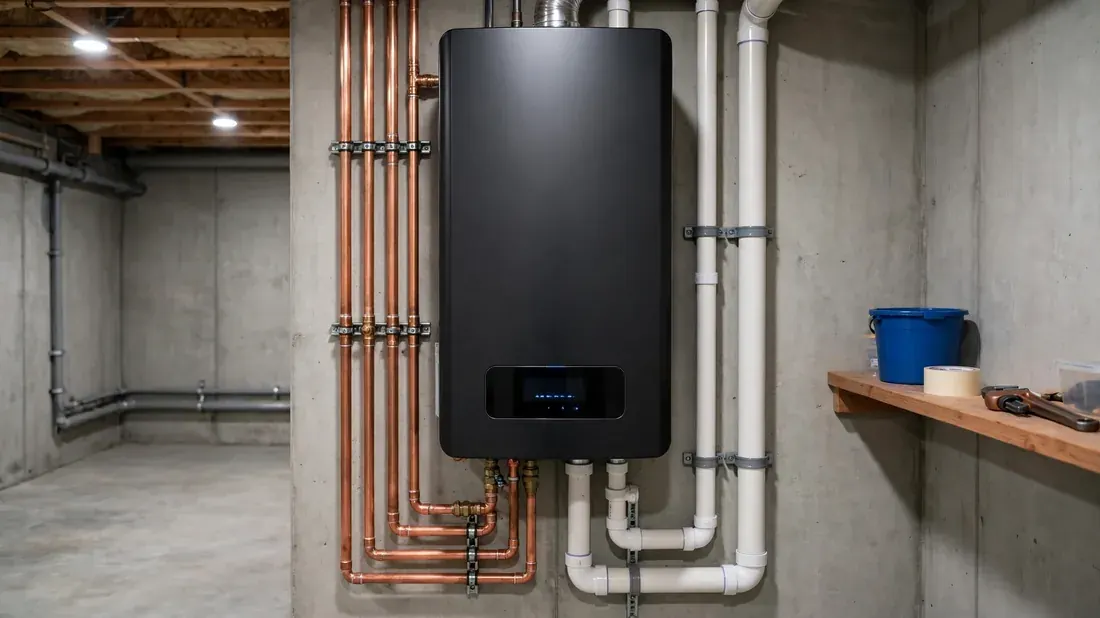
A tankless water heater makes hot water only when you ask for it — no tank to keep hot, no stored gallons to run out. For the right Columbus household it is a genuine upgrade; for the wrong one it is an expensive disappointment. Columbus Plumbing Help connects you with a local plumber who will size a unit by your real flow demand, check what your gas line and venting can support, and tell you honestly whether tankless fits your home.

Instead of gallons, tankless units are rated by flow: how many gallons per minute they can raise to temperature. That rating drops as incoming water gets colder — and Columbus groundwater in January is cold, which means a unit's winter output is meaningfully lower than its headline summer number. Sizing from the winter figure, against your home's simultaneous demand (a shower plus a dishwasher plus laundry), is the whole ballgame.
Gas tankless units also ask more of the house. They burn at a much higher rate while running than a tank burner, so the gas line that fed a tank heater often needs upsizing, and venting is typically a dedicated run rather than the old flue. Electric whole-home tankless units exist but demand very heavy electrical service that many panels cannot spare. None of this is a reason to avoid tankless — it is a reason the site survey matters more than the brochure.
Columbus's water makes maintenance part of the deal. Mineral content scales the heat exchanger — the heart of the unit — and tankless heaters need periodic descaling flushes to hold their efficiency and flow. A home that will keep up a simple flush schedule gets the long service life tankless is known for; that expectation is set plainly before any conversion is recommended.
A conversion from a tank is rarely a like-for-like swap. The variables: gas line capacity (frequently the deciding factor), vent route, condensate drainage for condensing models, water connections repositioned to the wall unit, and descaling valves. In a home whose gas line already has capacity and a short vent path, the job is contained; in an older Columbus home with a long, small gas run, the line work is a real part of the scope.
That is exactly why the assessment comes before the quote-equivalent conversation: the confirmed scope you approve lists the unit and every infrastructure item it needs, so the installation day holds no surprises.
Demand is calculated at Columbus's cold incoming-water temperatures, not the flattering ratings on the box, and matched against your simultaneous-use pattern.
The existing gas supply, meter capacity and vent route are checked against the unit's requirements, and any upsizing is scoped before installation, not discovered during it.
Where gas is not available, the panel capacity question is answered honestly — whole-home electric tankless needs amperage many Columbus panels do not have spare.
Wall mounting, water and fuel connections, condensate handling where the unit type requires it, and venting run to code.
Isolation valves fitted so future flushes are straightforward, and a plain explanation of the flush rhythm Columbus water calls for.
If your household's peak demand or your home's infrastructure makes tankless a poor fit, you hear that — and what would serve you better — before any commitment.
Bathrooms, occupants, simultaneous-use habits, and what you have now. Tankless sizing starts from your peak, not your average.
Gas line size, meter, vent route and panel capacity (for electric) are verified against the candidate unit's requirements.
The specific unit, any line or vent work, and the full scope are confirmed with you before installation day.
The unit is mounted, connected and vented; flow and temperature are tested at multiple fixtures, including simultaneous draws.
Temperature settings, the descale schedule and the isolation valves are covered so the unit's upkeep is no mystery.
Gallons-per-minute at winter groundwater temperatures — the math that decides whether two showers and a dishwasher can really run together.
Line capacity and working pressure are verified under load so the burner gets what its rating assumes.
Pump-flush kits circulate a descaling solution through the heat exchanger — the periodic service that keeps scale from choking flow.
High-efficiency condensing units produce condensate that must be drained and, where required, neutralized — planned into the install, not improvised.
A household rationing showers around a tank's recovery, with guests turning the schedule into a negotiation.
On-demand hot water sized for the real peak, so showers run back to back without a recovery wait.
A 50-gallon tank filling a small utility closet in a compact Short North home, radiating standby heat year-round.
A wall-mounted unit the size of a suitcase, floor space back, and nothing heated while nobody is home.
A neglected tankless heater losing flow and tripping errors as scale builds in its exchanger.
Exchanger descaled, isolation valves confirmed, and a flush schedule the owner can actually keep.
The situations this service exists for — described the way homeowners describe them on the call.
For households whose demand is spread through the day rather than stacked in one hour, on-demand heating ends the outage pattern entirely.
No stored water means no heat bleeding away around the clock, and a wall-mounted unit frees the floor footprint a tank consumed.
Tankless units carry a longer expected service life than storage tanks when maintained — no tank of standing water corroding from inside.
That depends on the unit's flow rating at winter water temperatures and everything else drawing at the same moment. A correctly sized unit handles a typical Columbus household's simultaneous draws; an undersized one delivers lukewarm disappointment. The sizing step exists precisely to answer this for your home before you commit.
Often, yes. Tankless burners fire at a much higher rate than tank burners while running, and many existing lines were sized only for the old tank. The assessment measures your line and meter against the unit's demand, and any upsizing is included in the confirmed scope.
Periodic descaling of the heat exchanger — Columbus's mineral content makes this the essential habit — plus keeping the inlet filter and vent clear. Units fitted with isolation valves make the flush a routine service visit. Skipping flushes is the main way owners shorten these units' lives.
It can be, with honest sizing: large households with heavy simultaneous peaks sometimes need a higher-capacity unit or a pair. What tankless will not do is forgive undersizing — so the peak-demand conversation happens first, and if a high-capacity tank is the better fit for your pattern, that is the recommendation you get.
Tankless units fire when flow starts, so there is a short ramp before full temperature — plus the water already in the pipe between the unit and the tap still has to travel. Placement near the main bathrooms and, in larger homes, recirculation options are part of the design conversation.
Burst pipe, sewage backup or water pouring where it should not be? This is the urgent-help service for active plumbing emergencies.
Slow sinks, gurgling tubs and drains that keep clogging. Cabling and cleaning for kitchen, bath and main lines across Columbus.
No hot water, rusty water, rumbling tanks and leaks at the base. Diagnosis and repair for tank water heaters across Columbus.
Old tank at the end of its life? Sizing, placement and installation of replacement tank water heaters, with the old unit removed.
Water bill up, damp spots, the sound of running water with everything off. Non-invasive leak detection that finds the source before opening walls.
Backups, root-filled laterals and broken sewer lines. Camera diagnosis first, then repair or replacement scoped to the actual damage.
The pump that stands between an Ohio storm and your finished basement. New installations, replacements and battery backup systems.
Gas smells, corroded lines and lines that need moving or extending for an appliance. Careful, pressure-tested gas line work — safety first, always.
High-pressure water scouring for grease-choked kitchen mains and lines a cable cannot truly clean. Jetting restores the pipe's full bore.
Running toilets, weak flushes, leaks at the base and phantom refills. Tank, valve, seal and flange repairs — and honest replacement advice.
One call describes the job once and matches it with an independent local plumber who serves your city.
📞 Call (610) 992-4884Mon–Fri 7 AM–10 PM · Sat 8 AM–10 PM · Sun 7 AM–9 PM ET
One way in: the phone. Call, describe the problem, and the matching starts. That is the whole system — by design.
Tap to call the intake line — one number for all 18 cities.
✉For non-urgent questions about the service.
Mon–Fri 7 AM–10 PM · Sat 8 AM–10 PM · Sun 7 AM–9 PM
Describe the problem once — where it is, what it is doing, when it started — and the intake matches you with an independent local plumber who serves your city.
📞 Call (610) 992-4884 or write to us rankandrent2+plumber-columbus@gmail.com