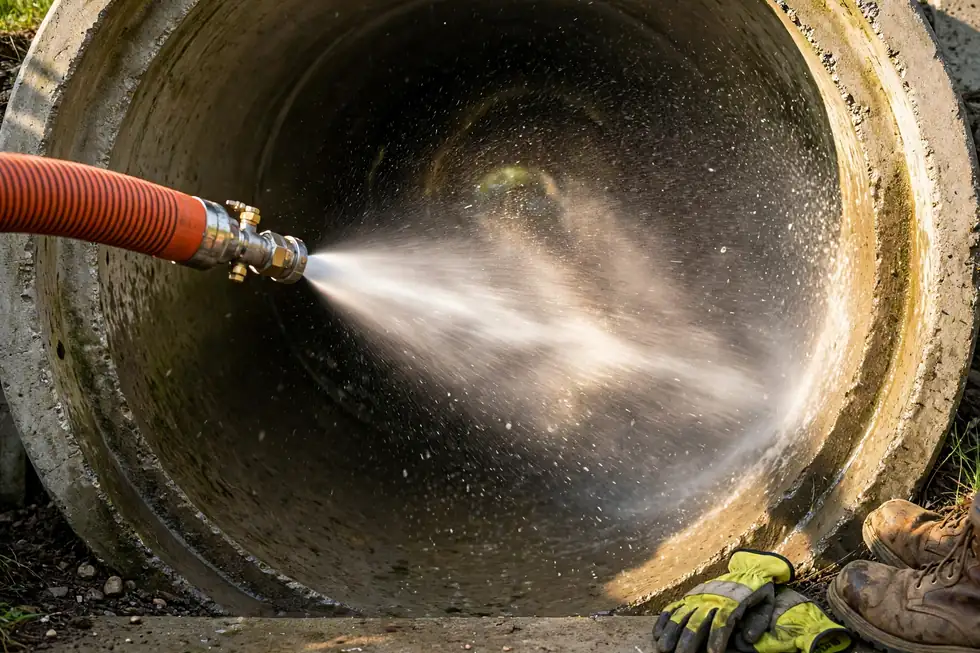
A cable punches a hole through a blockage; a hydro jet cleans the pipe. High-pressure water scouring strips grease, scale and debris from the full circumference of the line, restoring the bore the pipe was built with. Columbus Plumbing Help connects you with local plumbers who jet lines where jetting is the right tool — and who will tell you when a cable, or a repair, is the better answer.

A jetter is a pump, a hose and a nozzle that turns water into the cleaning tool — thousands of PSI directed backward and forward so the hose pulls itself through the line while jets scour the walls. What it removes is the stuff cables slide past: the grease film that coats kitchen mains, the scale that narrows old cast iron, the sediment bedded in a line that has run slow for years. The result is not a tunnel through a clog but a clean pipe.
Columbus's restaurant-dense corridors are not the only grease story — home kitchen lines in older housing carry the same film, built meal by meal. Add hard-water scale inside cast-iron drains in German Village, Clintonville and the older suburbs, and lines can lose a third of their bore without a single solid blockage. Those are jetting's home turf: chronic slowness, repeat grease clogs and lines that need resetting to clean before a camera can judge them.
Jetting has limits, and they matter. A line that is broken, offset or collapsed needs repair, not pressure — jetting a shattered pipe cleans the pieces. Fragile, paper-thin corroded pipe can be damaged by pressure that sound pipe handles easily. This is why jetting is usually paired with a camera: clean the line, then look at it, and know what you actually own.
Scope is the length and condition of the line: a kitchen main from cleanout to sewer is a contained job; a whole-house set of branch lines plus the main is a bigger one. Heavy grease or scale loads take more passes. Access matters too — a proper cleanout makes everything faster than working through a fixture trap.
The boundary condition is pipe soundness. If assessment or the first camera look shows breakage, jetting stops being the scope and the repair conversation begins — you approve that change with the evidence on screen, not on faith.
The line's material, age and condition are assessed first — jetting is prescribed where the pipe can take it and the blockage type calls for it.
The jetting hose works the length of the line in passes, stripping grease, scale and debris from the walls and flushing everything downstream to the main.
Grease lines are jetted from the correct access with nozzles chosen for coating removal, not just penetration.
After root cutting, jetting washes the fragments and loosened material out, leaving the line verifiably clear rather than hopefully clear.
Where the job calls for it, a camera run after jetting shows the restored bore — and the true condition of the pipe beneath the buildup.
If a cable clears your problem for good, or a repair is what the pipe actually needs, jetting is not sold to you on ceremony.
Repeat grease clogs, chronic slowness, a line that never stays cleared — jetting is prescribed from the line's biography as much as its symptom.
The cleanout or access point is opened and the pipe's material and condition assessed before any pressure is applied.
The nozzle works through the line section by section, scouring walls and flushing debris downstream until the return water runs clear.
Fixtures on the line are run hard to confirm full, fast drainage with no backing or gurgling.
Lines jetted for chronic problems get a camera pass afterward, so the now-visible pipe can be judged on its merits.
Trailer and portable jetters delivering the pressure and flow that scouring requires, with pressure matched to the pipe's material and condition.
Penetrating nozzles to open a path, flushing nozzles to carry debris, and spinning nozzles that scrub the full circumference of the wall.
Slow, deliberate passes on grease lines — the film comes off in layers, and rushing a pass leaves the coating that causes the next clog.
The before-and-after witnesses: what the buildup hid, and what the cleaning revealed.
A kitchen main that needed cabling every year, each visit punching through grease that sealed back within months.
Line jetted to bare pipe wall, the full bore restored, and the annual appointment cancelled by results.
A cast-iron main so scaled and sludged that a camera could see nothing but the blockage it was meant to diagnose.
Jetting cleared the bore, the camera ran clean, and the pipe's actual condition — sound, as it turned out — was finally visible.
Every drain in the building sluggish, tenants plunging weekly, the main coated with years of mixed buildup.
Main line jetted end to end, fixtures throughout the building draining at full speed on the same afternoon.
The situations this service exists for — described the way homeowners describe them on the call.
Cables bore through grease; jets remove it. For kitchen mains with a clogging rhythm, that difference is the difference between management and a cure.
Columbus's aging cast iron loses bore to mineral scale year by year. Scouring restores diameter that no cable can.
Some lines cannot be assessed until they are clean. Jetting is the prerequisite that makes an honest camera inspection possible.
A snake (cable) rotates a cutting head that bores a path through a blockage — excellent for roots, hair and solid obstructions. Jetting uses high-pressure water to scour the pipe walls clean — superior for grease, scale and sludge that coat the whole circumference. Many chronic lines need the cable first and the jet second; the assessment decides which yours needs.
On sound pipe, no — pressures are matched to the material. On pipe that is already cracked, offset or corroded paper-thin, pressure can worsen damage, which is exactly why the line is assessed first and why fragile lines get a cable or a repair instead. The tool is powerful; the prescription is the safeguard.
When it is done properly — full-bore scouring, not a quick pass — a home kitchen main typically stays clear far longer than a cabled one, because the coating the grease rebuilds on has been removed. The rhythm depends on what the household sends down the line; prevention habits (grease in the trash, not the sink) extend any cleaning's life.
Any line with a heavy grease or mixed-use load shows the biggest difference — duplexes, multi-bath homes and food-heavy kitchens. But the classic candidate is the ordinary older Columbus home whose kitchen main has clogged on a yearly cycle.
Both have their moment: a quick look first can rule out breakage that changes the plan, and a full inspection after jetting judges the cleaned pipe accurately. On chronically failing lines, the after-jetting camera is the one that finally shows the truth.
Burst pipe, sewage backup or water pouring where it should not be? This is the urgent-help service for active plumbing emergencies.
Slow sinks, gurgling tubs and drains that keep clogging. Cabling and cleaning for kitchen, bath and main lines across Columbus.
No hot water, rusty water, rumbling tanks and leaks at the base. Diagnosis and repair for tank water heaters across Columbus.
Old tank at the end of its life? Sizing, placement and installation of replacement tank water heaters, with the old unit removed.
Hot water on demand, no storage tank. Tankless installation and conversion guidance for Columbus homes that fit the pattern.
Water bill up, damp spots, the sound of running water with everything off. Non-invasive leak detection that finds the source before opening walls.
Backups, root-filled laterals and broken sewer lines. Camera diagnosis first, then repair or replacement scoped to the actual damage.
The pump that stands between an Ohio storm and your finished basement. New installations, replacements and battery backup systems.
Gas smells, corroded lines and lines that need moving or extending for an appliance. Careful, pressure-tested gas line work — safety first, always.
Running toilets, weak flushes, leaks at the base and phantom refills. Tank, valve, seal and flange repairs — and honest replacement advice.
One call describes the job once and matches it with an independent local plumber who serves your city.
📞 Call (610) 992-4884Mon–Fri 7 AM–10 PM · Sat 8 AM–10 PM · Sun 7 AM–9 PM ET
One way in: the phone. Call, describe the problem, and the matching starts. That is the whole system — by design.
Tap to call the intake line — one number for all 18 cities.
✉For non-urgent questions about the service.
Mon–Fri 7 AM–10 PM · Sat 8 AM–10 PM · Sun 7 AM–9 PM
Describe the problem once — where it is, what it is doing, when it started — and the intake matches you with an independent local plumber who serves your city.
📞 Call (610) 992-4884 or write to us rankandrent2+plumber-columbus@gmail.com